Service
Crime Prevention Surveys.
CPTED-trained walk-throughs that find the structural reasons your property has incidents — and the structural fixes that make them stop. Apartment communities only.
CPTED-trained walk-throughs that find the structural reasons your property has incidents — and the structural fixes that make them stop. Apartment communities only.
Property managers tend to frame crime as a staffing problem. "We need more patrol. We need a guard at the gate. We need cameras at the pool." Sometimes that’s right. More often, the property has a structural problem that no amount of guarding can fully fix. The breezeway at unit 312 is unlit at 2am because the fixture has been out for four months. The shrubs along the parking lot grew to seven feet and now block every camera’s view of the cars. The dumpster corral has a six-foot wall on three sides so anyone behind it is invisible from the leasing office. The pedestrian gate by the pool has a hole in the fence ten feet to its left.
Crime Prevention Through Environmental Design — CPTED — is a fifty-year-old discipline that treats those structural problems as the actual security work. Lighting, sightlines, landscaping, signage, territorial markers, natural access control. The discipline has been adopted by police departments, federal agencies, and major-property insurers because it reliably works: fix the dark corner, the incidents at the dark corner stop. Fix the sightline-blocking shrub, the parking lot break-ins drop. Add proper signage and you change who feels welcome — and who feels watched.
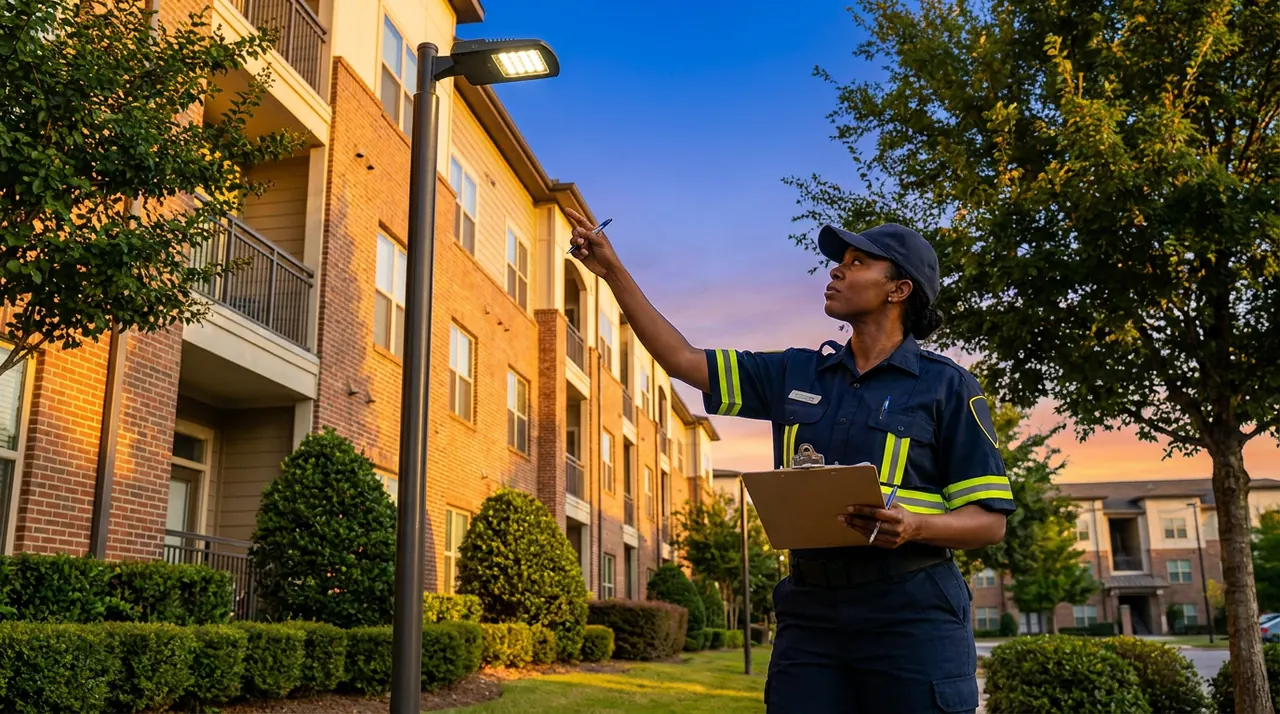
Our CPTED surveyors are trained in the methodology and have done nothing but multifamily survey work for years. We walk your property twice — once in daylight, once after dark, because half of what matters only shows at night. We photograph every flagged condition. We document which CPTED principle it violates. We recommend a specific fix with a rough cost band and a priority rank. You get a 20-to-40-page report you can hand to ownership, your insurance carrier, and your operations vendor. The fixes pay for themselves — and so does the lawsuit-defensibility of having documented this work.
Generic "security audits" are usually a templated sales pitch. A CPTED survey is a discipline with documented methodology — and a deliverable that holds up under scrutiny.
Site plan, recent incident log, prior surveys (if any), known problem zones from the manager.
3–5 hours daylight survey, then 2–3 hours after dark. Photographs, foot-candle readings, GPS tags.
5–7 business days. Findings mapped to CPTED principles, ranked by impact and cost, with specific recommendations.
In-person or video walk-through with the surveyor. Q&A. Implementation roadmap. Quote for fix-work if you want it.
CPTED surveys are priced per property as a fixed engagement, not per hour or per square foot. A typical 240-unit garden-style community is one rate. A 600-unit mid-rise with structured parking is a different rate (more vertical surface area, more breezeway complexity, more lighting variables). The fee covers daylight + after-dark walks, written report, and the ownership briefing.
What shifts the rate: property size and complexity, whether you want a re-survey after implementation (most owners do this 6–12 months after the fixes — it’s priced at a discount because the baseline is already done), and whether you want CPTED training for your property staff as an add-on. Site-plan markups, photo archives, and digital reports are always included.
Every assessment is free. The full CPTED survey is its own engagement with a fixed deliverable — quoted property-specific. We’ll show you what comparable apartment communities have paid against your size and layout.
A CPTED surveyor trained on retail, schools, or office campuses can identify the broad strokes anywhere — lighting, sightlines, signage. But multifamily has its own playbook. A school survey doesn’t have a pool deck at 11pm with intoxicated residents. A retail survey doesn’t have a mail kiosk that’s a daily delivery target. An office survey doesn’t have a garage stairwell that’s also a resident’s only walk to their unit.
Multifamily CPTED is the discipline applied to the specific frictions of resident life. We know that the natural surveillance from a leasing-office window matters most between 4pm and 8pm when staff is there and crime risk is highest. We know that a "well-lit" pool deck for swim party hours is too dark at 3am for the residents walking past it. We know that a six-foot dumpster wall meets code but makes the dumpster area a fight cave for non-residents. We’ve walked enough properties to know which design choices look great on the original architect’s drawing and fail in operation.
That experience is what owners actually pay for. Anyone with a clipboard can recommend "more lighting." We tell you which fixtures, at which height, on which path, with which lamp temperature, controlled by which sensor, with which downstream impact on resident sleep — because we’ve done all of those before and watched them work or fail at properties like yours.
Crime Prevention Through Environmental Design — a 50-year-old discipline that uses physical design (lighting, sightlines, landscaping, signage, access points) to reduce criminal opportunity. Adopted by HPD, FBI, and most major-city police departments as a recommended methodology. The core idea: fix the environment and you reduce the incidents that environment encourages.
On-site walk-through takes 3–5 hours for a typical 240-unit community — once during daylight and once after dark, because lighting issues only show at night. Written report with prioritized fixes is delivered within 7 business days. Then we schedule an in-person briefing.
A CPTED-trained surveyor (typically with an ICA CPTED Practitioner credential and 5+ years of multifamily-specific experience). Not the same person who staffs your front desk. The survey is its own discipline — we don’t cross-staff this work from patrol officers.
A 20–40-page document with photographs of every flagged area, the CPTED principle each finding violates, the recommended fix, a rough cost band, and a priority rank (immediate / 90-day / annual). Designed for ownership review, not just a manager handout. Most clients walk it through their insurance carrier within two weeks of receipt.
No. The report ranks every finding by impact and cost — owners typically address the top 5–10 high-impact, low-cost items first (relamp dim corners, trim sightline-blocking shrubs, add signage). The full backlog is yours to budget over time, and the priority rank lets you justify capex requests with documented risk reasoning.
A documented CPTED survey with implementation tracking is one of the strongest premises-liability defenses available. It shows the property identified risks and acted on them. We are not lawyers — but the strongest claims defenses we’ve seen have CPTED reports attached. Some insurance carriers also credit a recent CPTED survey toward premium calculations.
Better sightlines = better cameras. CPTED tells you which camera angles matter and which are wasted.
ExplorePatrol routes optimized against actual problem zones — not whoever drew the route last year.
ExploreCPTED identifies where fences, gates, and credentialed doors should actually go — not just where they currently exist.
ExploreFree intake call to scope your CPTED survey. Most fixes pay for the survey within a year. Premises-liability defense is the bonus.