Service
Courtesy Patrol
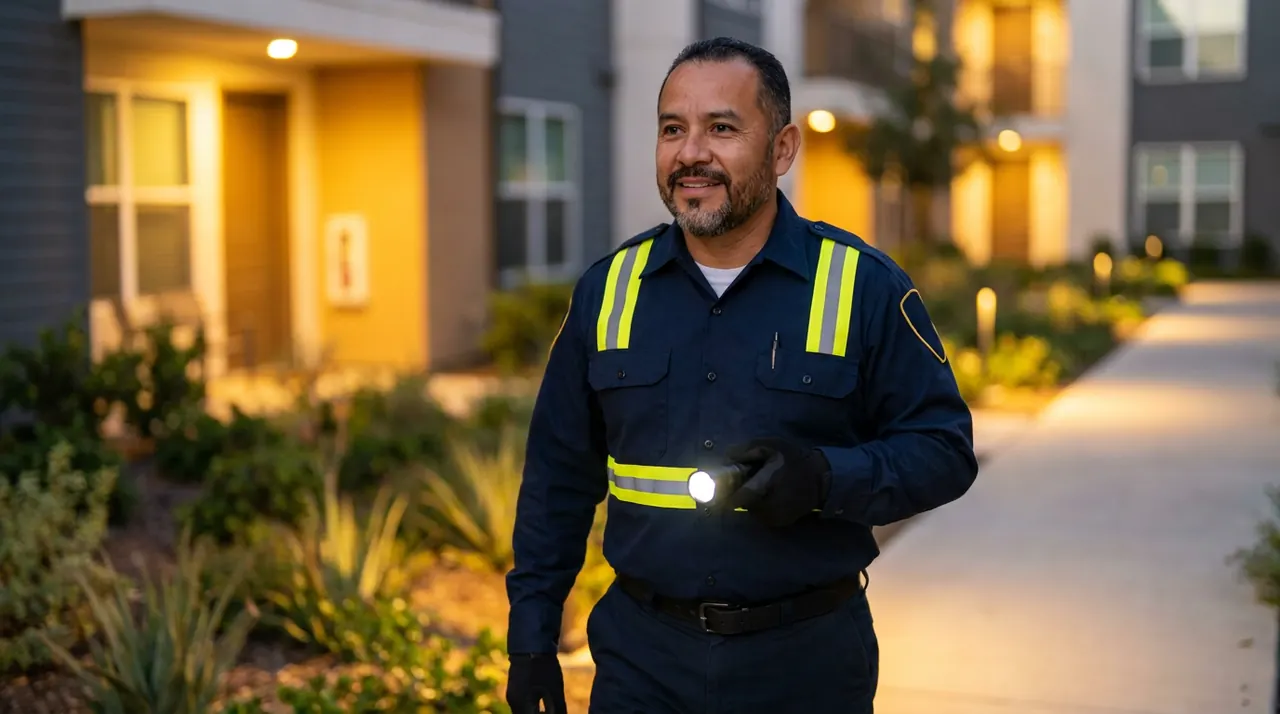
Eyes on your community, around the clock — and only on multifamily. Marked vehicles, uniformed officers, randomized rounds, GPS-logged. Houston apartment communities, condominiums, townhomes. Nothing else.
Eyes on your community, around the clock — and only on multifamily. Marked vehicles, uniformed officers, randomized rounds, GPS-logged. Houston apartment communities, condominiums, townhomes. Nothing else.
A patrol shift starts the moment our vehicle rolls onto your property — not when the officer clocks in across town. The first pass is slow and deliberate: pool deck, gym, mail kiosks, leasing office perimeter, garage stairwells, dumpster corrals. The officer is photographing burned-out exterior lights, checking pedestrian gates, and looking for the cars that don’t belong. Every observation goes into the dispatch log with a timestamp and a GPS coordinate.
Between rounds, the officer is a visible presence — sitting in a marked vehicle near the front entrance during peak resident-arrival hours, walking the breezeway when a noise complaint comes in, asking the group of teenagers on the bench at 11pm whether they live here. That visibility is the actual deterrent. By the second week of patrol on a new property, the cars that used to cruise the parking lot stop showing up. The non-resident loitering in the laundry room stops happening. It’s not magic. It’s the math of someone who watches doing the watching.
When something does happen — an unauthorized car, a domestic spilling into the parking lot, a stranger trying door handles — the officer is already onsite, in uniform, with a body camera, with a direct dispatch line, with a criminal trespass agreement on file. That changes the timeline from "someone is calling 911 and we’ll see how long HPD takes" to "the situation is being managed within 30 seconds and HPD is being called by a uniformed witness." That difference is the entire reason multifamily owners hire courtesy patrol.
No "premium tier" gotchas. The list below is what every patrol contract delivers from day one — whether your property is 80 units or 800.
A licensed surveyor walks the property at the same hour you’re losing sleep over. Identifies risks. No charge, no obligation.
We price by post-hour against your actual layout and risk profile. Not a per-unit copy-paste rate.
Trespass agreement filed with HPD. Officers walk the property with your manager. Resident notice posted.
Marked vehicle on property, randomized rounds, GPS logs, morning report. Month-to-month after the first 30 days.
Courtesy patrol is priced by post-hour. A "post" is one officer plus one marked vehicle on a defined shift — for example, one officer covering 6pm to 6am, four nights a week. Multiply the post-hours by the officer level (Level II unarmed, Level III armed) and that’s your monthly number.
What changes the rate within a contract: armed vs. unarmed, shift length, supervisor rotation frequency, and whether you need overlap during shift change. A typical Houston multifamily property running night-only Level II patrol lands in a predictable monthly band — we’ll show you the exact number against your specific layout during the free assessment.
Every assessment is free. Quotes are property-specific. Month-to-month after a 30-day pilot — no annual lock-in.
A retail patrol officer is trained to walk a perimeter, deter shoplifting, and lock up at 10pm. An events patrol officer is trained to manage crowds. A corporate-campus patrol officer is trained to check badges. None of those skill sets are what a 280-unit apartment community needs at 2am on a Saturday.
Multifamily patrol is its own discipline. Our officers know how to spot the rented U-Haul that’s actually an unannounced move-out at 11pm (because that’s often a skip and that’s often where TVs get stolen). They know which units tend to have weekend domestic-disturbance calls. They know that the kid sitting alone in the leasing-office breezeway at midnight is almost always a resident locked out, not a trespasser — and how to verify it without scaring them.
That’s what specialization buys you. Not a uniform — judgment. And the only way to build that judgment is to do nothing else. Which is exactly what we do.
Standard contracts include 4–8 inspection rounds per shift, randomized so the schedule is never predictable to bad actors. Higher-risk properties scale up. Each pass is GPS-stamped and timestamped — you can see exactly when the officer hit the pool, the gym, the mail kiosk, and the back garage stairwell.
We staff both Level III (armed) and Level II (unarmed) officers. Most multifamily contracts run Level II with armed backup on-call — that’s the right balance for typical Houston apartment risk. Higher-incident properties may need Level III on every shift. Your property’s actual risk profile drives the recommendation.
Every contact is logged in our dispatch system with body-camera footage and photo evidence. Routine matters appear in the morning report. Active threats get an immediate phone call to your designated emergency contact. Police are contacted any time the situation requires it — we don’t hesitate, and we don’t cover things up to protect a contract.
Yes. We help you file a criminal trespass agreement with HPD during onboarding, and we coordinate the legally-required posted notices. Parking enforcement follows your written policy — we don’t freelance.
Yes. Amenity sweeps are part of every round — pool deck, gym, leasing office perimeter, mail kiosks, laundry rooms, garage stairwells, dumpster corrals. The places residents complain about are exactly where we focus the most.
Yes. Night-only is actually the most common contract shape for our clients (typically 6pm–6am, four to seven nights a week). We also offer weekend-only, holiday-only, and 24/7 coverage. Match the shift to the actual incident timing on your property.
Live operator behind the cameras you already own — doubles the deterrence per dollar.
ExploreGate, fob, and credential systems that actually get audited — not just installed.
ExploreLighting, sightlines, gates, signage — the structural fixes that reduce incidents before they happen.
ExploreFree assessment. No obligation. We’ll show you what we see and quote what it actually costs.