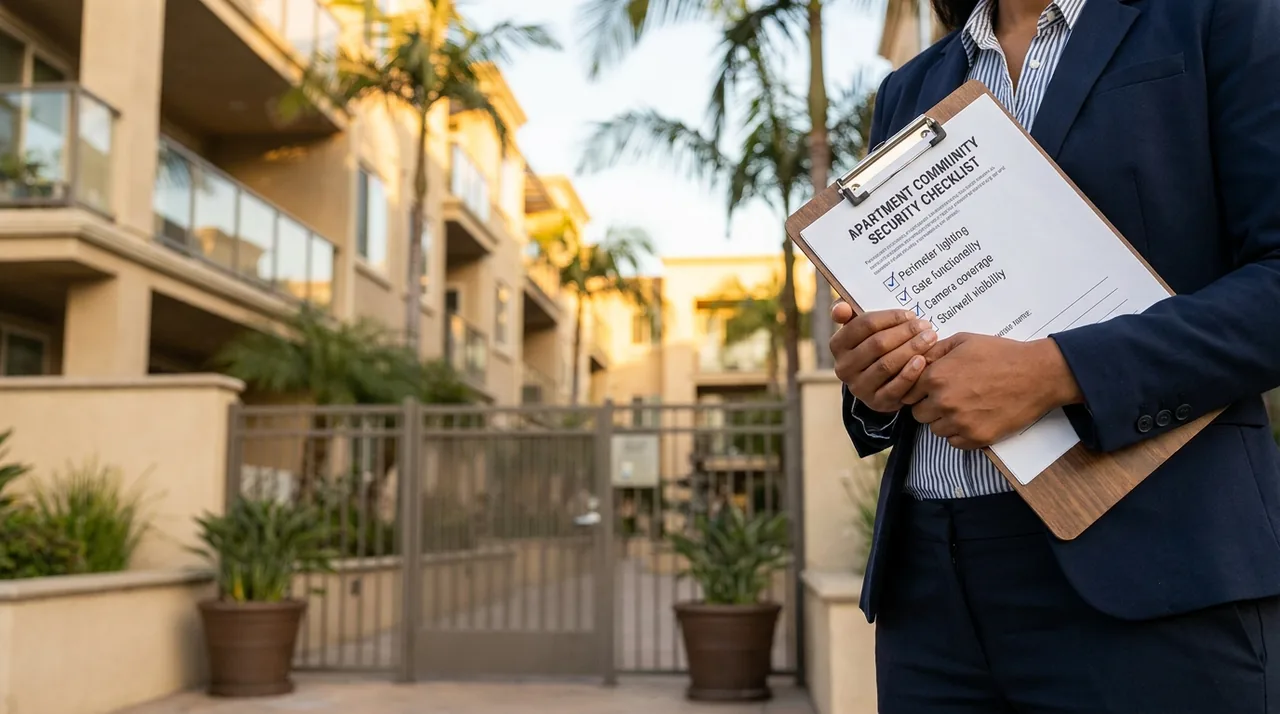
Houston security firm. Only multifamily. Nothing else. That single line is the entire reason this checklist exists. Generalist security companies write checklists that mix retail, office, event, and apartment work. The result is a document that tries to be everything and ends up being useful nowhere. The list below is the opposite. Every item came from an actual call on a real apartment community somewhere between the Galleria and Pearland. If something never mattered on a multifamily call in eleven years, it is not on the list.
Use this on day one of a new property assignment. Use it on day 90 of a property you already manage and think is fine. Use it the week after an incident, when the leasing office is asking what changed and the regional is asking who is responsible. The checklist is forty-seven items long, grouped by perimeter, common areas, parking, residential entry, technology, staff, and documentation. Read it once end to end, then walk the property with it on a tablet.
How to read the checklist
Each item should produce a clear answer of yes, no, or partial. A “partial” deserves a written note about exactly what is missing. The point is not to tick boxes. The point is to surface the three or four findings worth fixing this quarter. If forty-five items pass and two fail, those two will be where your next incident comes from. Trust the gaps the walk surfaces — do not rationalize them away because the rest of the property looks polished.
In our experience auditing communities that called us after an incident, more than half of the issues that contributed to the incident were already known to staff for at least sixty days before it happened. The checklist is not a discovery tool. It is a forcing function for the conversation that should already be happening at the weekly staff meeting.
Section 1 — Perimeter (items 1–9)
- Fence line continuity. Walk the entire perimeter. Note any breach in fencing, missing pickets, or natural paths worn through landscaping that bypass the fence. A gap behind the dumpster is a gap.
- Gate operation under load. Test the vehicle gate three times in a row. Does it close fully between cars when traffic is light? Does it stick open during peak ingress? A gate that fails open at 5:45 p.m. is a gate that is open all night.
- Pedestrian gate latch. Pedestrian gates fail more often than vehicle gates. Cycle each one. Latches that have to be slammed are latches that residents prop.
- Posted notices. Are “No Trespassing” signs posted at every entry, visible from a public right-of-way? Texas Penal Code 30.05 makes posting a foundation of any later trespass charge. We cover this in detail in our trespass-law post.
- Sight lines from the street. Walk the public sidewalk that runs along the property at night. Can you see into common areas, or is the property a hedge wall? Hedges that block residents from being seen also block officers and police from seeing them.
- Lighting at the perimeter. At 11 p.m., walk the outside edge. Mark every fixture that is out, flickering, or has migrated into landscape overgrowth. Photograph the bulbs you cannot read fixture numbers on.
- Camera coverage of perimeter ingress. Every vehicle entry and pedestrian entry should have a fixed camera with a clear face shot and a clear plate shot. Two separate angles, not one camera trying to do both.
- Trash and rear-of-building access. The dumpster enclosure, valet trash staging, and rear maintenance doors are where after-hours problems start. Item: are these areas locked, lit, and on camera?
- Adjacent property risk. What is on the other side of your fence? A vacant lot, a strip center with late-night traffic, a public park? Adjacency drives 70–80% of perimeter risk in our experience patrolling Houston.
Section 2 — Common areas (items 10–18)
- Pool gate and fence. Self-closing, self-latching, code-compliant height. Most municipalities require specific spec; verify against the local building department, not the property’s memory.
- Pool deck after-hours. Are hours posted? Is the gate actually locked at posted closing time? An unlocked pool at 1 a.m. is a magnet for guests-of-guests-of-guests.
- Fitness center access control. Fob-only entry, not a propped door. Camera covering the entry and at least one floor-level angle.
- Mail room and package room. The single highest theft-incident location on most properties. Camera angle should capture face at entry and plate of any cart leaving full.
- Business center and lounge. After-hours access policy posted. Cameras visible. Furniture configured so blind corners are minimized.
- Laundry room. Often unstaffed and easily forgotten. Single point of entry. Lighting. Posted hours. Camera covering the door.
- Stairwells. Lit, swept, not used for storage. Where stairwells exit to parking, the door should not be propped.
- Elevators and elevator lobbies. Camera in cab, mirror at lobby corner. Emergency call working — test it monthly.
- Playgrounds and dog parks. Hours posted, lighting adequate, sight lines from a leasing office or staffed area.
Section 3 — Parking (items 19–25)
- Lighting uniformity. The ratio between brightest and darkest point of any parking lot should not exceed 6 to 1. Walk it with a phone light meter app at night if you do not have a professional meter.
- Reserved spot enforcement. If towing policy is published, it must be enforced consistently. Selective enforcement is a liability story waiting to happen.
- Visitor parking signage. Visitor spots clearly marked and limited. Unlimited visitor parking encourages non-residents to treat the lot as a meeting point.
- Covered parking access. Many properties have covered parking that doubles as a hiding spot at night. Lighting under covers should match open-lot lighting, not fall off to gloom.
- Camera coverage of lot. Every aisle should have at least one camera with usable image quality at night. A camera that produces a blob of pixels at 10 p.m. is decoration.
- Tow company signage. Texas requires specific posting for any property that tows. Verify the posted phone number actually answers.
- Resident car-burglary clusters. Pull your last six months of vehicle break-in reports. If three or more clustered in the same row, that row needs intervention — lighting, camera reposition, or patrol pattern change.
Section 4 — Residential entry (items 26–33)
- Door hardware on units. Deadbolts working, strike plates secured with 3-inch screws, peepholes intact.
- Sliding patio doors. Secondary security bar or pin available. Tracks clean.
- First-floor window stops. Window stops or pins to limit opening on ground-floor and patio-accessible windows.
- Unit-key control. Who has master keys? Where are they stored? When was the last audit? A community with no recent key audit has effectively no key control.
- Vacant-unit security. Vacant units locked, no keys hanging in lock boxes outside the unit, no “agent-on-site” sign that doubles as a beacon for opportunists.
- Make-ready process. Make-ready vendors signed in and signed out. Vendor list reviewed quarterly.
- Resident package handling. Where do residents pick up packages? If the answer is “the leasing office hallway,” expect periodic theft.
- Entry-call box and intercom. Functional. Not stuck in a perpetual loop on one resident’s programmed number from three years ago.
Section 5 — Technology (items 34–39)
- Camera DVR/NVR uptime. Are all cameras recording? When did the system last record a full 30 days without a gap? Most properties find a gap when they go to pull footage during an incident.
- Retention window. 30 days minimum, 60 days strongly preferred. Anything less than 30 days fails the typical police request timeline.
- Backup power on cameras and gates. When the power goes out, does the gate fail open and the camera DVR shut off? If yes, your worst-case window is an open property with no recording.
- Network segregation. Cameras, gates, and resident wifi should not share the same flat network. Cybersecurity is increasingly a multifamily issue.
- Software updates on access systems. Vendor patches applied within 90 days of release. Old firmware on an internet-connected access controller is an open door.
- Mobile credential program. If you offer mobile credentials, what happens when a resident loses their phone? See our access control comparison for the trade-offs.
The single most common technology failure on multifamily properties is camera coverage that exists on paper but produces unusable footage at the exact moment it is needed. Test your system by pulling a random night clip every month and asking whether you could identify a face. If the answer is no, the cameras are not protecting the property even though the budget line says they are.
Section 6 — Staff and policy (items 40–45)
- Officer assignment continuity. Is the same patrol team assigned to your property week over week, or rotating? Continuity beats rotation for multifamily — residents learn faces, officers learn patterns.
- Incident log review. Weekly review of officer reports by the property manager. Patterns surface only when someone is reading the reports.
- Eviction protocol. Documented eviction-day staffing pattern. See our service page on eviction standby for what should be in this protocol.
- Trespass-warning workflow. Who issues trespass warnings? Where are they logged? How is the list shared with the patrol team?
- Resident complaint loop. When a resident reports a safety concern, what is the response time and who closes the loop with them?
- Emergency contact tree. Property manager, regional, security vendor, local police district number. Posted at the leasing office and in the security closet.
Section 7 — Documentation (items 46–47)
- Insurance and certificates of insurance. Current COI on file from every vendor on property, security included.
- Annual security review on the books. Calendar reminder, every year, same week. Walk the property with the checklist again. Compare findings year over year — the trend line is the real signal.
What to do with the result
The checklist is not the end of the work. Once you have your gaps, group them by cost. A handful will be free or near-free: re-aiming a camera, posting a missing sign, locking a door that has been propped for three months. These are the items you finish before the end of the same week as the walk. A second group costs hundreds: replacing a bulb, fixing a latch, repainting a parking line. These are next-thirty-day items. A third group costs thousands or more: rewiring a camera run, replacing a gate operator, adding a new patrol shift. Those go on the next budget cycle with the checklist findings as supporting documentation.
The mistake we see most often is staff who finish the walk and then have nowhere to put the findings. The walk becomes a one-time exercise instead of a quarterly rhythm. Build the rhythm first and the checklist becomes a living document.
Where specialists differ from generalists
A generalist security firm walking the same property will produce a different list. Some items will be missing because the firm does not see them — the patio-door pin, the mail-room cart angle, the vacant-unit key-box rule. Other items will be present that do not belong — retail-style POS checkpoints, event-style perimeter staging, office-style badge controls that nobody on an apartment property will use. Specialization is not a marketing claim. It is the reason the list above looks the way it does. We have walked hundreds of Houston multifamily communities. We have walked zero offices, zero retail centers, and zero stadiums. That focus is the value.
Key takeaways
- The forty-seven items above cover perimeter, common areas, parking, residential entry, technology, staff, and documentation — the seven failure surfaces of a multifamily property.
- Most gaps are already known to staff before they cause an incident. The walkthrough forces those gaps into a written log that drives action.
- Group findings by cost. Same-week fixes, thirty-day fixes, and next-budget fixes — not one long undifferentiated list.
- Repeat the walk annually at minimum, quarterly if you can. The year-over-year comparison is the real diagnostic.
- Multifamily-only specialization changes which items make the cut. Lists built for retail or office work miss what apartment communities actually need.